

Building the Market Infrastructure for Adaptation Finance in Africa By Sarah Njoroge and Margaret Nakunza
Why the binding constraint in African adaptation finance is market infrastructure rather than capital — and what our Community of Practice is doing about it.
Africa’s adaptation finance needs are estimated at around USD 70 billion a year. The most recent tracked flows came to USD 14.8 billion, and agriculture and food systems, the sector that employs the majority of the continent’s workforce, received roughly a quarter of that.
The instinctive response is to call for more capital. But in our advisory work across East Africa, capital availability is rarely the binding constraint. There are DFIs, funds and foundations whose mandates comfortably cover a solar irrigation portfolio or a drought-tolerant seed company. The capital exists; the transactions don’t reach it in a form it can underwrite.
Consider two banks, one in Nairobi and one in Kampala, both lending to climate-smart agriculture. Each applies its own definition of climate-smart, tracks its own indicators, and reports against no common standard, so an investor assessing the two portfolios together cannot aggregate them into anything resembling an asset class. Each bank also holds its exposures alone, which means a loan that fails credit committee on a standalone basis might have priced acceptably as one position in a pooled portfolio. And both are running full due diligence on the same small set of bankable borrowers that everyone else is already courting.
In our reading, this is a coordination failure as much as a funding gap, and coordination failures can be addressed deliberately, through shared market infrastructure.
How the Community of Practice came together
None of this is a new diagnosis. Practitioners in African climate finance have been describing these problems for years. What changed at the Sankalp Africa 2026 Summit – Sankalp Forum’s flagship convening (an Intellecap initiative), held in Nairobi in February, was the appetite in the room. People stopped describing the problem to each other and decided to do something about it.
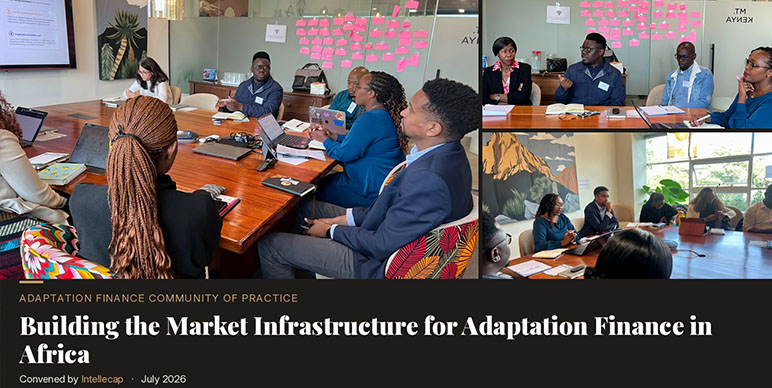
While most good conference conversations die in the taxi to the airport. This one didn’t. On 6th May we convened the first working session: twenty-four institutions on a virtual call, working through where exactly the market breaks down and what shared infrastructure might look like. Intellecap, as convener, then developed that diagnosis into a concept note. On 1st of July the group reconvened to stress-test it.
The design held up, with useful amendments. More importantly, the session closed with a working group in place committed to developing the first component.
What we are building
We are calling it the Adaptation Finance Commons. It is shared market infrastructure rather than a fund that no single institution owns and any member can use it. It has three components.
The first is a shared measurement standard: a common definition and indicator set for resilience lending, so that results can be aggregated and compared across lenders for the first time. The second is pooled risk infrastructure: a shared first-loss reserve and guarantee facility, structured so that no single lender carries the full risk of an unfamiliar borrower class alone. The third is an open pipeline registry: a common list of investment-ready agri-SMEs, appraised against the agreed criteria and accessible to any member with capital or support to offer.
There is precedent for infrastructure of this kind changing how capital behaves. For instance, off-grid solar remained a niche allocation until GOGLA’s Off-Grid Solar Resilience and Adaptation Framework gave buyers and investors a common basis for comparison; standardization preceded the entry of commercial capital at scale. Measurement standards are unglamorous work, but in our experience, they are often what converts a development priority into an investable market.
Where we are now
The July session produced commitments, not just endorsements. Several institutions offered on the spot to co-develop the measurement standard, and a working group has been formed around it. The bankers in the room were candid about why the guarantee instruments currently in the market often go under-utilised. This feedback will directly shape the design of the risk layer. One of the DFI participants made a point that for resilience to be lendable, it has to be expressible as a number a credit officer can work with, not a narrative in a sustainability report. Early conversations are also under way on anchor funding for the risk pool
We are starting in Kenya, where several banks are already piloting climate-linked lending and the market is deep enough to test the model properly. Once the approach has proven itself there, the design is intended to be replicable across the region.
An open question
We have been asking every participant the same question:
“What is the one thing you cannot do alone in adaptation finance that you would commit to doing together?”
The Commons is, in effect, the aggregate of the answers, and its value grows with each institution that joins. If your organisation has capital to deploy, pipeline to nominate, or technical expertise to contribute, there is room at the table.
The next working session is being planned now. To take part, email Sarah Njoroge at sarah.njoroge@intellecap.net.
Editor’s note: The 1 July session was the Community of Practice’s second working session since the Sankalp Africa 2026 Summit, following the first virtual session on 6 May.
Hosted by Intellecap in hybrid format at The Riverfront, #Nairobi, it brought together participating institutions including ACRE Africa, Co-operative Bank of Kenya, Equity Group, Equity Bank Limited, @Gotabet Nurseries, IFC – International Finance Corporation, The World Bank Group, Manufacturing Africa, Mastercard Foundation, Norfund, Nura Global Innovation Lab (formerly Pears Program for Global Innovation), P4G Partnerships, Stanbic Bank Kenya, Sunken Limited, UNHCR, the UN Refugee Agency and VestedWorld, alongside the Intellecap team.
Related Articles
Our Impact Map