

When the “Unprecedented” Becomes Routine: What Europe’s Summer of Heat Tells the Global South
The heat didn’t let up this year, like many previous years — but this time it hit Europe’s markets like never before. A good time to see what the Global South has already been doing for this.
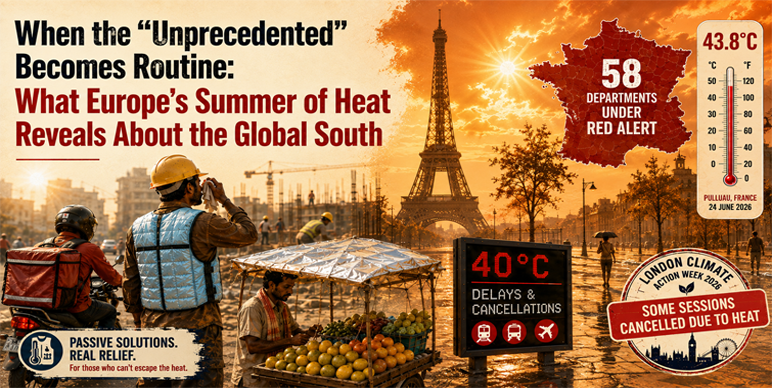
Paris just recorded its hottest day in history. Twice, in the same week. On 24 June 2026, the national average temperature hit 30.0°C, breaking a record set the day before — beating marks set in 2003 and 2019 — with the town of Pulluau touching 43.8°C. France issued a Red Alert across 58 departments, nearly the entire country. Germany, the Czech Republic and Poland saw transport networks buckle at 40°C. Spain logged over 1,000 excess deaths in what turned out to be its second-hottest June on record. By the time the third heatwave of the season arrived in early July, meteorologists had stopped calling it unusual.
The Irony No One Scripted
The irony that no one scripted was London Climate Action Week 2026 had sessions cancelled — because of the heat.
An event convened to discuss the climate crisis was disrupted by the climate crisis. Panels on adaptation strategies, resilience planning, and emissions pathways were called off so that organizers and attendees could avoid the very conditions those panels exist to address.
Sometimes the weather makes the argument better than any speaker on any panel could.
For a continent whose cities, transit systems and buildings were engineered for a temperate climate, this summer has been a rupture. Commentators have called it a preview of what an ordinary European summer could look like by mid-century. But for hundreds of millions of people across the Global South, that “preview” is not a warning about the future. It is Tuesday.
The Gap Between Europe’s Emergency and the Global South’s Everyday
What made Europe’s heatwave front-page news was its departure from the baseline — a 43.8°C day is remarkable precisely because it isn’t normal there yet. In much of India, it already is. Nagpur, Delhi, and dozens of other cities routinely cross 42–44°C for weeks at a stretch every summer.
Which is really the contrast worth sitting with: 43.8°C in France made history. In parts of India, it barely makes the forecast. Same number, completely different meaning.
The difference isn’t just degrees on a thermometer. It’s also who gets to retreat indoors when the heat hits, and who doesn’t. Nearly 71% of the global workforce — at least 2.41 billion people — are currently exposed to excessive heat on the job, according to the International Labour Organization.
This is the double burden of the Global South: it faces the highest cooling demand and the least access to cooling.
Building Cooling for Those Who Have Nowhere to Cool Off, the Intellecap Way
Think about what “cooling” even means for someone who doesn’t have four walls to put an AC in. A delivery rider on a two-wheeler, a construction worker on scaffolding, a fruit seller pushing a cart from lane to lane — none of them can step into an air-conditioned room when the heat gets unbearable, because stepping indoors isn’t part of the job. For that entire category of worker, the standard advice (“stay hydrated, avoid the sun, use a fan”) isn’t really advice at all. It’s a description of a life they don’t get to have.
That gap — between who needs cooling most and who can least afford the conventional version of it — is what Intellecap’s SPACES programme (Scaling Passive Affordable Cooling for Environmental Sustainability, run with Shell Foundation and Trane Technologies) is trying to close. An AC or a fan is useless to someone who works on their feet, outdoors, all day. So instead of a cheaper version of the same product, SPACES is backing things that need no electricity at all — designed to be worn or mounted, and priced from the start at $10–100, not marked down from something premium.
It’s already out of the pilot stage. This summer, over 2,500 Zomato delivery partners across 14+ Indian cities started wearing passive cooling vests — soak them, wring them out, and evaporation does the rest, keeping riders workable above 40°C for hours at a stretch on bikes with no shade and no way to clock out of the heat. Beyond that, more than 7,000 outdoor workers in Delhi, Mumbai, Chennai, Kolkata and Nagpur now have access to similar vests (6–8°C of relief) alongside reflective films that can drop rooftop and cart-canopy temperatures by 10–12°C, just by bouncing back 97% of the sun hitting them. No power, no plumbing, no ongoing cost beyond water.
None of it would exist without capital willing to fund something unproven. Shell Foundation covered the cost for pilot partners, which is the only reason this moved from an idea to a vest on someone’s back in months rather than years. It’s not charity so much as market-building — proving something works well enough that commercial supply chains eventually pick it up on their own.
The real lesson from this summer: Europe’s heatwave made headlines because it broke records. Heat in the Global South rarely makes headlines, because for the people living it, nothing’s breaking — it’s just what summer is. That’s exactly why something like SPACES matters. It isn’t built for someone deciding whether to turn the AC on. It’s built for someone who has no choice but to be outside when it hits 44°C.
As “extreme” quietly becomes “expected” everywhere, the real test won’t be how well cities handle the next record-breaking week. It’ll be whether the people who are outside every single day — heatwave or not — finally have tools built for their reality.
To learn more about the SPACES programme or explore partnership opportunities, reach out to the Intellecap Climate team at climate@intellecap.net or visit intellecap.com.
Sources: International Labour Organization; World Meteorological Organization; Météo-France; Reuters; Al Jazeera (World Weather Attribution analysis); LinkedIn updates from Intellecap and Shell Foundation team members on the SPACES programme; Intellecap’s “A Holistic Approach to Tackling Heat Stress in the Global South.”

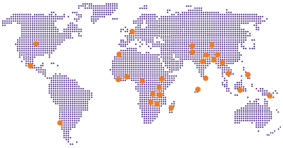
Our Impact Map